Since everyday objects can now be connected to the internet, the IoT (Internet of Things) has now become a daily reality for many. With the increased use of these IoTs, there has come a larger market for IoT batteries.
The new demands of connecting everything
In recent years, Amazon launched their AWS IoT, Microsoft their Azure IoT Suite, and many another tech Giants, like Xiaomi and Alibaba, their own platforms. With these large companies promoting the technology and pouring in the necessary capital and resources, it is no wonder that the IoT battery market has seen demand and development.
Markets and Markets, an international market research agency, said that the “global IoT market demand for batteries will reach $9.2 billion by 2020, and this figure is expected to increase to $15.9 billion by 2025, at a CAGR of 11.6% over the period." According to the agency, the key factors driving the rapid and steady growth of this market are the exponential growth in IoT usage, increased adoption of IoT devices, and increased global demand for wireless communications.
It is reported that current IoT batteries are mainly used in IoT appliances, such as car remote keys, smart door locks, smart medical devices, smart home appliances, and wearable devices. Unlike traditional electrical appliances, IoT appliances need to support the signal at any time in the rapid connection between devices and even need to support the signal transmission to the cloud. In general, these types of IoT batteries require long life and high reliability, so lithium batteries are the main power source.
Markets and Markets note that the Asian-Pacific IoT battery market, including China, is expected to grow at an ultra-high CAGR in the future. Major manufacturers of wearable devices and consumer electronics are making their product designs miniaturized, and these products require miniature power supplies to be compatible with the designs. In addition, technological advancements in smart packaging and the adoption of medical devices that require lightweight, flexible, and secure technical power sources are driving the growth of the micro battery market in the Asian Pacific.
IoT Battery Applications
It is not difficult to imagine that with the general trend of the IoTs, the demand for power in all kinds of IoT applications may well follow.
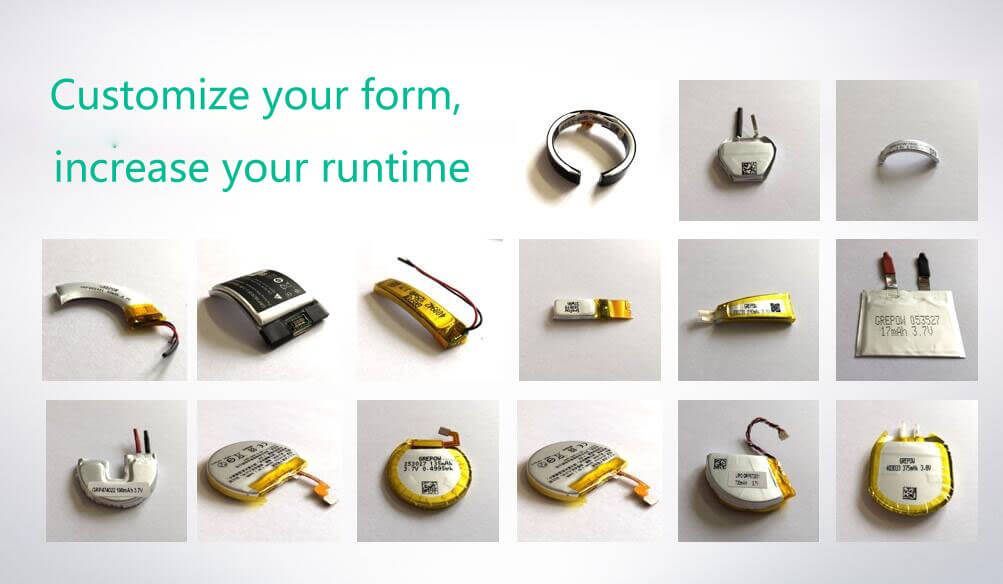
Grepow, one of the largest battery manufacturers in the world, provides all-in-one battery solutions and customer-service teams that provide excellent fast customization and response. In addition, Grepow’s shaped batteries are expected to have more applications in the wearable field, and the company has developed its own core equipment and products for these batteries.
Grepow started manufacturing shaped batteries in 2014 to provide excellent IoT power solutions to eco-partners in the IoT market. Currently, Grepow provides dozens of IoT battery solutions for automotive tire pressures, water meters, smart gas meters, smart fire hydrants, smart door locks, smart agriculture, smart good covers, smart smoke sensors, etc.
It is important to note that, in order to transmit data on changing environmental conditions, the IoT relies on wirelessly connected sensors. These sensors are often located in remote locations and, in many application scenarios, have the disadvantage of a possible uncharged power supply.
In this regard, Grepow's IoT batteries have the advantages of long standby time, operation in high and low temperatures, and high technical compatibility for many special applications. Grepow’s IoT batteries have been applied in intelligent logistics, intelligent animal husbandry, and other fields, and they provide safe and reliable battery solutions for many IoT ecological partners.
If you are interested in any of our products, please feel free to contact us for further details at info@grepow.com
The rising cost of public and private healthcare services means that the entire healthcare industry is constantly looking for innovative ways to achieve and maintain the highest quality of service while keeping costs as low as possible. Technological innovations mean improved usability and longevity without compromising the accuracy and safety of the device and the maximum use of custom medical batteries in the design and manufacturing process.
The importance of customized medical batteries
Custom medical batteries are vital in the healthcare industry.
In the healthcare industry, critical equipment must have autonomy and fail-safe features, which has led to the widespread use of battery backup systems designed and built into each unit. Custom medical batteries can also help ensure that the right power performance requirements are met but the ideal solution is provided in the most efficient way possible. This ensures that your time-to-market, prototyping, and testing costs are kept to a minimum, thus providing you with the help possible.
Battery solutions for medical devices and systems must be reliable and up to standard from the start. Design, attention to detail, thorough and precise testing, and high-quality manufacturing processes are critical to the delivery of these custom medical batteries.
Reliable medical battery manufacturer
Grepow has been researching, developing, and manufacturing batteries for more than 20 years, and we are an industry-leading manufacturer of LiPo medical batteries. From our inception, we have cooperated with many of the Top 500 Companies in the world.
Grepow custom batteries can be made in micro dimensions: 0.4 mm to 8 mm in thickness, 6 mm to 50 mm in width. Different forms, capacity, and C-Rate are available on request. We have more than 200 engineers and 3000 skilled workers and are able to respond quickly to any need the industry may have for us.
The working current for most medical wearable devices is within 0.5C. Grepow’s medical wearable battery life can go as high as 1000 cycles; after 1000 cycles, the capacity is maintained over 80%.
Grepow’s custom medical batteries are designed and manufactured in line with all the batteries and custom battery packs we manufacture: we follow the highest quality in assurance and development standards in the battery industry. Our goal is to ensure that our customers expect the highest quality when developing life-critical medical applications.
Our experienced team of custom medical battery engineers advise clients on the right type of battery for their applications (whether they are for defibrillators, patient monitors, medical devices, diagnostic tools, ultrasound devices, mobile products, or other specialized medical devices).
Please send an email to info@grepow.com if you have any inquiries or concerns regarding your project or product.
The price of lithium-ion polymer (LiPo) batteries is mainly determined by their cell, PCM or PCB (Protection Circuit Module or Board), and casing. The material used between cells, such as a conventional or formed nickel sheet and connectors also affects the cost of the batteries.
Battery selection
Different materials
The selection of cells of different chemical materials affects the price of the entire lithium battery. There are various materials such as lithium manganese (3.6V), lithium cobaltate (3.7V/3.8V), lithium nickel cobalt manganate (also called ternary, 3.6V), lithium iron phosphate (3.2V), lithium titanate (2.3V/2.4V), etc.
Different chemical materials have different voltage platforms, safety factors, cycle life, energy density, operating temperature, etc.
Different brands
The prices of different cells vary depending on the brand. The price gradient can be divided into the following groups: special batteries (including low-temperature batteries, high-temperature batteries, high C-rate batteries, shaped batteries), Japanese batteries (Panasonic, Sanyo, Sony), Korean batteries (Samsung, LG), Chinese batteries (Piccolo, BYD, ATL, GREPOW).
Lithium battery’s PCM or PCB
The PCM design can be divided into three parts: basic protection, communication, and a BMS
Basic protection
There are basic protections against overcharge, over-discharge, overcurrent, and short-circuit protection, and even over-temperature protection can be added according to product requirements.
Communications
Communication protocols can be divided into I2C, RS485, RS232, CANBUS, HDQ, SMBUS, etc. There is also a simple battery LED indicator which indicates the charger meter.
BMS
The BMS is a battery management system that maintains each battery cell to prevent overcharging and over-discharging, extend battery life, and monitor the battery status. Its main functions include real-time monitoring of the battery’s physical parameters; battery status estimation; online diagnosis and warning; charge, discharge, and pre-charge control; and balanced management and thermal management. Subsystems are mostly used in electric vehicle batteries.
Designs of Lithium battery cases
Lithium battery case designs can consist of PVC heat seal, plastic, or metal. The specific type of outer case of a battery depends on the specific needs of a customer’s product.
PVC Heat Seal
Heat-sealed PVC packaging of a battery pack can be generally used for battery packs that have an overall weight ≤ 2kg. For battery packs with an overall weight of ≥1kg, it is necessary to add a fixing bracket between the cells and then to use a PVC heat seal.
Plastic
The costs behind plastic casing can vary depending on the tools (tooling costs are a big expenditure), plate shell proofing (handmade strength is not as good as molded products), and materials used.
Metal
If a product has not been shaped before or the demand is not high, it is generally recommended to use sheet metal especially as the lead time can be shorter. The cost depends largely on the water-resistant rating for metal housings and even more so for special materials such as titanium alloy.
The price of Lithium-ion Polymer Batteries is mainly composed of the battery cell, PCM, and structural parts, plus the PACK cost, aging cost, and management cost of the enterprise. At the same time, due to the technical difficulty of the product, procurement volume, defective rate of different requirements, lithium battery prices will vary greatly.
If you are interested in our cost-effectivebattery products, please don’t hesitate to contact us at any time! Email: info@grepow.com Grepow Website: https://www.grepow.com/
There are many kinds of anodematerials for lithium-ion batteries. Depending on the cathode material, they can be divided into lithium cobaltate, lithium manganate, ternary materials, lithium iron phosphate, and lithium titanate.
A ternary lithium battery is a lithium battery that uses three metal oxides, nickel, cobalt, and manganese, as anode material. Since it combines the advantages of lithium cobaltate, lithium nickelate, and lithium manganate, the performance is superior to any of the above single anode materials. The experimental analysis indicates that the three different valence elements form a superlattice structure, and there are obvious synergistic effects between the three components, which makes the material more stable and the discharge platform is as high as 3.6V, so it is considered to be the most promising.
The current research on ternary materials mainly focuses on the preparation of precursors, the synthesis of materials, and the relationship between electrochemical properties and structure. Most of the transition metal elements Ni, Co, Mn exist in the +2, +3, +4. In the process of charging and discharging, the only electrochemical reactions are Ni2+/Ni4+ and Co3+/Co4+. Participation in the electrochemical reaction only serves to stabilize the structure of the material.
The commonly used synthesis methods in the industry include a high-temperature solid-phase, co-precipitation, sol-gel, hydrothermal synthesis, and combustion. By changing the molar ratio of the three materials in a ternary lithium battery within a certain range and adding the corresponding additives (binder, conductor, fluid collector, etc.), we can obtain outstanding performance and create batteries like the ultra-low temperature ternary lithium battery.
We will explore three ternary lithium batteries in this article.
Table of Contents
Ternary polymer lithium battery’s electrolytes
A ternary polymer lithium battery refers to a lithium battery that uses a lithium metal cobalt lithium manganate (Li(NiCoMn)O2) ternary positive electrode material and a gel polymer electrolyte. As the transmission medium of ion motion, the electrolyte generally consists of a solvent and a lithium salt. The electrolyte of a lithium secondary battery mainly has a liquid electrolyte, an ionic liquid electrolyte, a solid polymer electrolyte, and a gel polymer electrolyte.
The gel polymer electrolyte is composed of a polymer, an organic solvent, and a lithium salt, and is obtained by mixing an organic electrolyte and a solid polymer matrix. Because it exists in a gel state, it has the advantages of both a solid electrolyte and a liquid electrolyte. Since the electrolyte is confined in the polymer chain, it has a high ionic conductivity over a wide temperature range. The biggest advantage is that the diaphragm is mechanically strong and the film provides a large surface area. The thinner the film, the higher the energy density as more active material can be embedded in the cell. In addition, the electrolyte has good electrochemical stability and high-temperature resistance; in fact, most high-temperature batteries on the market use polymer electrolytes.
Ternary power lithium battery
A ternary power lithium battery is a battery that supports high rate, high current discharge, high power density, and more energy being released per unit time. The rate discharge capability refers to the ability to maintain the battery capacity in the case where the charge and discharge rate is increased. The charge and discharge rate is expressed by C: 1C means that the nominal capacity of the battery can be used up in 1h, and the discharge at 2C can be used for 30min.
The power/rate performance of the battery is closely related to the design of the battery and is affected by many factors such as the electrolyte, diaphragm, type of active material, size of active particles, etc.
Among these factors, the thickness of the electrode is a major factor that affects the ability to have a large current discharge. The rate discharge capability can be greatly improved by thinning the electrode because thin electrodes have a small electronic impedance and ion impedance inside. However, thinning of the electrode results in less active mass in the electrode, and thus the battery capacity is reduced. Therefore, the main technical challenge of the ternary power lithium battery is to increase the large current discharge capability without reducing the capacity.
Ternary low–temperature lithium battery
The temperature characteristics of this battery are an indicator of battery reliability, and the performance of the battery can also be evaluated by changing the ambient temperature.
The low-temperature characteristics of lithium batteries mainly consist of low-temperature discharge characteristics and cycle life. Low-temperature batteries must maintain low-temperature conditions of material mobility so that lithium ions can freely pass between the positive and negative electrodes to achieve successful charge and discharge.
For example, using an electrolyte with a low melting point and reducing the particle size of the active material will enhance the low-temperature performance of the battery. This is due to the increased channeling of lithium ions, which, to some extent, compensates for the slow movement of lithium ions at low temperatures.
Ternary lithium batteries now
At present, ternary lithium battery manufacturers at home and abroad can basically achieve a discharge temperature of -20℃, a discharge capacity of more than 50%, and cycle life of about 400 cycles. These can generally satisfy ordinary electrical appliances.
However, in special applications, such as aerospace, military equipment, or extreme cold environments, lithium batteries must be able to achieve lower discharge operating temperatures to meet demanding conditions. GREPOW has gathered a large number of electrochemical experts and engineers in the industry to successfully develop a low-temperature -40℃ discharge with a discharge capacity of 67%. It is mainly used for ultra-low temperature lithium batteries for military and special applications.
If you are interested in a ternary power lithium battery, please don’t hesitate to contact us at any time. Email: info@grepow.com Grepow Website: https://www.grepow.com/
Lithium is the lightest metal with high specific energy, and it has the smallest atomic mass (its atomic weight is 6.94g/mol, ρ=0.53g/cm3).
A ternary power lithium battery is a lithium secondary battery that uses nickel-cobalt-manganese, three transition metal oxides, as the cathode material. It integrates the good cycling performance of lithium cobaltate, the high specific capacity of lithium nickelate, and the high safety and low cost of lithium manganese.
Ternary power lithium battery also synthesizes the synergistic composite inlaid lithium oxide, such as nickel-cobalt-manganese, using molecular level mixing, wrapping, and surface modifications. the ternary power lithium battery is a type of lithium-ion rechargeable battery that is widely studied and used.
Ternary power lithium battery life
Lithium battery life refers to the battery after a period of use specifically when the capacity of the battery has decayed to 70% of the nominal capacity (at room temperature 25 ℃, standard atmospheric pressure, and battery capacity discharged at 0.2C). The industry generally calculates the cycle life of a lithium battery by the number of full discharge cycles.
Over the course of use, lithium batteries undergo irreversible electrochemical reactions inside the battery, leading to a decrease in capacity, such as the breakdown of the electrolyte, the inactivation of the active material, the collapse of the positive and negative electrode structure, resulting in a decrease in the number of lithium ions embedded and de-embedded, etc.
Experiments have shown that higher-magnification discharges lead to faster capacity decay, and if the discharge current is lower, the battery voltage will be closer to the equilibrium voltage, which can release more energy.
The theoretical life of a lithium battery is about 800 cycles, which is moderate among commercially available rechargeable lithium batteries. Lithium iron phosphate is about 2,000 cycles while lithium titanate is said to reach 10,000 cycles.
Battery manufacturers promise more than 500 cycles under standard conditions in the specifications of their ternary batteries, but, due to consistency problems (the voltage and internal resistance can not be exactly the same), its cycle life is about 400 cycles. Manufacturers recommend the use of a SOC window of 10-90%, is not recommended for deep charge and discharge as it may cause irreversible damage to the positive and negative structure of the battery. In addition, if the lithium battery is frequently discharged in high magnification and high-temperature environment, the battery life can reduce to less than 200 cycles.
Ternary power lithium battery material
The ternary power lithium battery is a comprehensive and excellent battery with a balanced capacity and safety. The main roles, advantages, and disadvantages of the three metal elements are as follows:
Co3+ reduces cationic mixing occupancy, stabilizes the laminar structure of the material, reduces impedance value, improves conductivity, and improves cycling and multiplication performance.
Ni2+ can improve the capacity of the material (improve the volumetric energy density of the material); however, because lithium and nickel have a similar radius, too much nickel will also cause the dislocation phenomenon with lithium, resulting in lithium-nickel mixing. The greater the concentration of nickel ions in the lithium layer, the more difficult the lithium in the laminar structure, resulting in poor electrochemical performance.
Mn4+ not only reduces material costs but also improves the safety and stability of the material. However, too much Manganese will make the battery prone to the emergence of the spinel phase and destroy the laminar structure, resulting in reduced capacity and cyclic decay.
Ternary power lithium battery energy density
When compared to lithium iron phosphate, lithium manganate, or lithium titanate, high energy density is the biggest advantage of ternary lithium batteries. The voltage platform is an important indicator of the battery energy density, which determines the basic performance and cost of the battery. The higher the voltage platform, the larger the capacity.
The discharge voltage platform of a single ternary lithium battery is as high as 3.7V, 3.2V for lithium iron phosphate, and only 2.3V for lithium titanate, so, in terms of energy density, the ternary lithium battery has an absolute advantage over lithium iron phosphate, lithium manganate or lithium titanate.
Poor safety and short cycle life are the main shortcomings of ternary lithium batteries. Safety performance has especially been a major factor limiting its large-scale packaging and large-scale integrated applications. The 500-cycles cycle life in a lithium battery is medium to low, so the ternary lithium battery is the most important application field in 3C digital and other consumer electronics.
If you are interested in a ternary power lithium battery, please don’t hesitate to contact us at any time. Email: info@grepow.com Grepow Website: https://www.grepow.com/
When choosing a Bluetooth speaker, battery life is very important, which is about how long you can use it outside(it can be used outside). If the battery life is short, it is not suitable for outdoor use. This battery life is related to the capacity of the Bluetooth battery. So are the battery capacities of the Bluetooth speakers real? How can we replace the battery of the Bluetooth speaker?
Bluetooth speaker battery capacity
People seek long-term battery life of Bluetooth speakers, so the requirements on Bluetooth battery capacity will be higher.
If you don’t unpack or test, how do you know if the Bluetooth battery capacity or endurance time is real? At this time, you can acquire the fact. For example, a 500mA to 800mA Bluetooth speaker, its battery life usually is 3 to 5 hours.
It is also possible to calculate whether the battery capacity of the Bluetooth speaker is real. Battery capacity equals to using time multiplied by device power and then divided by the battery voltage. So we can calculate how many capacities of the battery when we buy a Bluetooth speaker.
How to replace the battery?
The battery of electronic products becomes less useful after the long run using, and the working time is greatly reduced. If you buy a Bluetooth speaker again, it may not be cost-effective. At this time, it is better to replace the battery of the Bluetooth speaker. (It could be more economical if you replace the battery instead of buying a new Bluetooth.)
Turn the bottom of the Bluetooth speaker upwards, tear off its anti-slip mat, you can see the maintained screw, remove it and unscrew it, and then use a soldering iron to heat and make battery on the audio motherboard drop off. Finally, new cables and matching plugs should be soldered together.
After the other end of the wire is welded to anode and cathode of the audio motherboard, fix the wire to it with double-sided tape. The two ends of the Bluetooth battery wire are respectively covered with tape. At this time, you can place the motherboard on the new battery. Close the bottom cover of the speaker, screw the screws back, and then stick double-sided adhesive to the bottom of the speaker, just stick the anti-slip mat back.
The above is how to replace the battery of a Bluetooth speaker. When buying a Bluetooth speaker, pay attention to whether the capacity of the Bluetooth battery and the endurance time is real. If it is a fake mark, the product quality is certainly not good.
Is there any guarantee for the safety performance of the Bluetooth headset battery? It is not fun to explore on ears.
Bluetooth headset type
Bluetooth headphones can be divided into three categories:
1. Mono
The single-channel Bluetooth headset is a single ear headset. It is mostly wireless and small style. It can be inserted directly into the ear. Its main function is to listen and hang the phone. It can control the volume, and the single ear type Bluetooth headset also has double, double, and rye techniques.
2. Stereophonic
Stereo headphones are based on smartphone support for A2DP Bluetooth stereophonic protocol. Only our mobile phone settings support A2DP Bluetooth stereophonic protocol, and you can connect stereo Bluetooth headphones to enjoy Bluetooth headset music. Stereo Bluetooth headset has neck hanging, headset, clip, glasses, and other styles, lyrics, and other functions.
3. Real wireless
The real wireless Bluetooth headset is very different from the traditional Bluetooth headset. The real wireless Bluetooth headset is based on the Multiplexlink multi-point wireless interconnect technology. The wireless connection between the left and right ears is realized, and the way of wire connection is completely abandoned, and the left and right earplugs can work independently.
Next, we are going to talk about the safety of the Bluetooth headset battery.
Bluetooth headset battery
First of all, the function of the latest version 2.1 of Bluetooth is achieved by saving the power consumption by setting the interval between the 2 devices to confirm the sending interval of signals. In general, when 2 connected Bluetooth devices are in the standby state, the Bluetooth devices still need to make sure that they are still in the online state through each other. Of course, because of this, the Bluetooth chip must keep the Bluetooth headset at any time, even if all the other components of the cell phone have entered. Dormant mode. In order to improve this situation, Bluetooth 2.1 prolongs the interval between the signal transmission time between the old version of the device from 0. to 0.5 seconds from the old version, so that the workload of the Bluetooth chip can be greatly reduced, and the Bluetooth can have more time to sleep completely. According to the official report, after this technology is used, the standby time of Bluetooth device can be effectively extended by more than 5 times after the Bluetooth connection is opened. Such a Bluetooth headset lithium polymer battery is in a state of low power consumption, and there will be no safety considerations.
At present, the market for Bluetooth headset batteries is made of lithium polymer batteries. GREPOW also produces the lithium polymer batteries used in Bluetooth products (common models include 150mAh, 60mAh, 30mAh, 75mAh, 90mAh). Compared with the liquid lithium-ion battery, this kind of lithium-ion battery is not only safe, but also has the advantages of thinning, arbitrary area and arbitrary shape, and the shell also uses a lighter aluminum-plastic composite film. However, there may be room for improvement in its low-temperature discharge performance. But at the moment, it is still the main body of the lithium headset of Bluetooth headset. Its advantages are small size, lightweight, large capacity, and so on.
Now our domestic lithium polymer battery is mostly only a flexible packaging battery, the shell is made of aluminum-plastic film, and the electrolyte has not changed. The lithium-polymer battery can also be thinned, and its low-temperature discharge characteristics are better than that of the polymer battery, while the material energy density is basically the same as that of the liquid lithium battery and the ordinary polymer battery, but because of the aluminum-plastic film, it is lighter than the ordinary liquid lithium. In safety, when the liquid is just boiling, the aluminum-plastic film of the soft battery will naturally burst or burst, and it will not explode.
Contact us for more Bluetooth headset batteries at info@grepow.com
There are many advantages to using Lithium-Ion Polymer (LiPo) batteries: High working voltage, high energy density, long cycle life, low self-discharge rate, and no memory effect. To fully utilize these aspects of LiPo batteries, users should aim to prolong the life of their batteries. In order to do so, LiPo batteries should not be overcharged or discharged as explored in this article.
Activating LiPo Batteries
Some may have heard that new LiPo batteries need to be “activated” and thus charged for more than 12 hours. This is sometimes commonly heard amongst people who have new mobile devices and consequently drain and charge their battery for 12 hours. This might have been true when Nickel batteries, such as Nickel-metal Hydrogen (NIMH) or Nickel Cadmium (NiCd) batteries, were the predominant power source for mobile devices; however, most mobile devices now use Lithium-ion batteries. Users do not need to drain and charge their mobile devices in such a manner anymore.
Do batteries need to be activated? Yes, but this process is completed by the manufacturer and has nothing to do with the user having to do so. The actual process involves charging the batteries at 0.02C and then charging them in standard charge and discharge cycles to check for certain standards, such as the internal resistance, voltage retention, and maximum capacity.
Overcharging
One of the most common ways that LiPo batteries are abused is in how people overcharge their batteries. If users leave their batteries charged for too long, the batteries can become damaged, performance can be lost, and the life span of the batteries can decrease.
Fortunately, there are many chargers that automatically stop charging a Lithium-ion battery when the battery is fully charged. However, there are some devices that do not stop on their own, so users should exercise caution in order to prolong the life of their batteries. Ultimately, shallow charge and discharge are beneficial to LiPo batteries.
There are also safety concerns especially when users use Lithium-ion batteries incorrectly. They can become too hot if they are overcharged As shown by the many videos online, explosions can even occur if users are not careful. Users should refer back to the instructional and cautionary guidelines behind the products that they are using.
Lithium batteries, or Lithium-ion Polymer (LiPo) batteries, are batteries that use Lithium as a negative electrode material and use a non-aqueous electrolyte solution. In 1912, Lithium metal batteries were first proposed and studied by Gilbert N. Lewis. In the 1970s, M.S. Whittingham proposed and started researching Lithium-ion batteries. However, due to the complications of using the unstable Lithium metal, the batteries were not popular at the time.
It is now with further development that Lithium-ion Polymer batteries have fast become a preferred power source for many applications and industries. It is for this reason that we will explore the charging cycles of lithium-ion polymer batteries in-depth in this article.
What is a charging cycle?
Some consumers may have that the charge and discharge life of lithium-ion polymer batteries is “500 times.” But what is “500 times?” It refers to the number of charge and discharge cycles of the battery.
Let us look at an example: Let us say there is a lithium battery that uses only half of its charge in one day and is then charged fully. On the next day, it again only uses half of its power. Although the battery has been charged twice, this does not count as one charge cycle but two.
A charging cycle is when a battery goes from being fully charged to empty and then from empty to fully charged; this is not one single charge. Just based on the previous example, it’s clear that it can usually take several charges to complete a cycle.
Every time a charging cycle is completed, the battery capacity decreases a bit. However, the reduced capacity is very small. High-quality batteries will still retain 80% of their original capacity after many cycles of charging. Many lithium battery products will still be used after two or three years. Of course, after the end of the lithium battery life, it still needs to be replaced.
Ultimately, a 500-cycle life means that a manufacturer has achieved about 625 recharge times at a constant discharge depth (such as 80%) and reached 500 charging cycles. In other words, if we ignore other factors that could reduce the Lithium-ion battery capacity and we take 80% of 625, we receive 500.
However, due to various factors in life, especially considering how the depth of discharge (DOD) during charging is not constant, “500 charging cycles” can only be used as a reference to battery life.
Overall, it is better to think of the life of the lithium battery as related to the number of times the charging cycle is completed and not as directly related to the number of charges.
Deep and shallow charging
Here is another way to think of the cycle lives of lithium-ion polymer batteries: the life of a Lithium battery is generally 300 to 500 charging cycles. Assume that the capacity provided by a full discharge is Q. If the capacity reduction after each charging cycle is not considered, lithium batteries can provide or supplement 300Q-500Q power in total during its life. From this we know that if you use 1/2 each time, you can charge 600-1000 times; if you use 1/3 each time, you can charge 900-1500 times. By analogy, if you charge randomly, the number of times is uncertain. In short, no matter how a Lithium battery is charged, it is constant to add a total of 300Q to 500Q of power. Therefore, we can also understand this: the life of a Lithium battery is related to the total charge of the battery and has nothing to do with the number of charges. The effects of deep charging and shallow charging on lithium battery life are similar.
In fact, shallow discharge and shallow charges are more beneficial to lithium batteries. It is only necessary to deep charge when the power module of the product is calibrated for lithium batteries. Therefore, lithium-ion-powered products do not have to be constrained by the process: they can be charged at any time without worrying about affecting the battery life.
Effects of temperature on battery life
If a Lithium-ion Polymer battery is used in an environment higher than the specified operating temperature (above 35℃), the battery’s power will continue to decrease. In other words, the battery’s power supply time will not be as long as usual. If a device is charged at such temperatures, the damage to the battery will be greater. Even if the battery is stored in a hot temperature environment, it will inevitably cause damage to the battery. Therefore, it is a good idea to extend the life of lithium-ion polymer batteries by using it under normal operating temperatures as often as possible.
If you use Lithium batteries in a low-temperature environment (below 4℃), the battery life will also be reduced. Some older Lithium batteries of mobile phones cannot even be charged under low temperatures. However, unlike in high temperatures, once the temperatures rise, the molecules in a battery will heat up and immediately return to the previous charge.
Having explored battery performance under these extreme temperatures, the question now becomes if there are any batteries that can be used in environments with low or high temperatures.
Currently, GREPOW’s batteries can be used at temperature ranges of -50 ℃ to 50 ℃ or 20 ℃ to 80 ℃. Our low-temperature Lithium batteries’ discharging current of 0.2C at -50℃ is over 60% efficiency, over 80% efficiency at -40℃, and around 80% efficiency at -30℃.
The graphs source by Grepow Low-temperature lithium batteryThe graphs source by Grepow Low-temperature lithium battery
Charge-discharge cycle
To get the most out of lithium-ion batteries, you need to use it often so that the electrons in the Lithium batteries are always in a flowing state. If you do not use lithium batteries often, please remember to complete a charging cycle every month and do a power calibration, i.e. deep discharge and deep charge, once.
After the nominal number of charge and discharge cycles is used up, a battery’s ability to store power will drop to a certain level, but the battery can continue to be used.
Lithium batteries have no limit on the number of times they can be recharged. Regular manufacturers can charge and discharge batteries at least 500 times, and the capacity is maintained at more than 80% of the initial capacity. If charged and discharged once a day, batteries can be used for two years. Usually, batteries in mobile phones are charged 1000 times or more, which causes the batteries to be severely non-durable.
Below is a proper method of maintaining your mobile device’s battery:
When you charge your phone, fully charge it each time.
Do not fully discharge the battery. The battery needs to be charged when the power is less than 10%.
Charge with the original charger; do not use a third-party charger.
Do not use your mobile phone while it is being charged.
Don’t overcharge: stop charging after the battery is full.
According to the experimental results, the life of a lithium battery continuously declines with an increase in the number of charges.
Lithium battery cycle specified by the national standard
In order to measure how long the rechargeable battery can be used, the definition of the number of cycles is specified. Actual users use a wide variety of tests because tests with different conditions are not comparable, and the comparison must define the definition of cycle life.
Lithium battery cycle life test conditions and requirements specified by the national standard are as follows:
Charge at 1C under the environment temperature of 20 ° C ± 5 ° C. When the battery terminal voltage reaches the charging limit voltage of 4.2V, change to constant voltage charging until the charging current is less than or equal to 1 / 20C, stop charging, leave it for 0.5h to 1h, and then discharge it at 1C to the termination voltage of 2.75V.
After the discharge is completed, leave it for 0.5h to 1h, and then perform the next charge and discharge cycle two consecutive times. Less than 36min, the end of life is considered, and the number of cycles must be greater than 300 times.
Having gone over the national standard, we should explain the following:
The standard specifies that the cycle life test is performed in a deep charge and deep release mode.
The cycle life of the lithium battery is specified. According to this model, the capacity is still more than 60% after ≥300 cycles.
However, the number of cycles obtained by different cycling systems is quite different. For example, the other conditions above are unchanged, and only the constant voltage of 4.2V is changed to a constant voltage of 4.1V for the cycle life of the same type of battery. In this way, the battery is no longer under a deep charge, and the cycle of life can be increased by nearly 60%. Then if the cut-off voltage is increased to 3.9V for testing, the number of cycles should be increased several times.
With regard to this statement that the charge and discharge cycle is one less life, we should pay attention to the definition of the charging cycle of a lithium battery: a charging cycle refers to the full charge of the lithium battery from empty to full, and then from empty to full the process of. And this is not the same as charging once.
In addition, when we talk about the number of cycles, we cannot ignore the conditions of the cycle. It is meaningless to talk about the number of cycles aside from the rules because the number of cycles is just a way to measure battery life.